Three belt moves I use on pear, apple, and petite frames when a in just adds bulk or cuts you in half.
Pear shapes: stop trying to shrink your hips
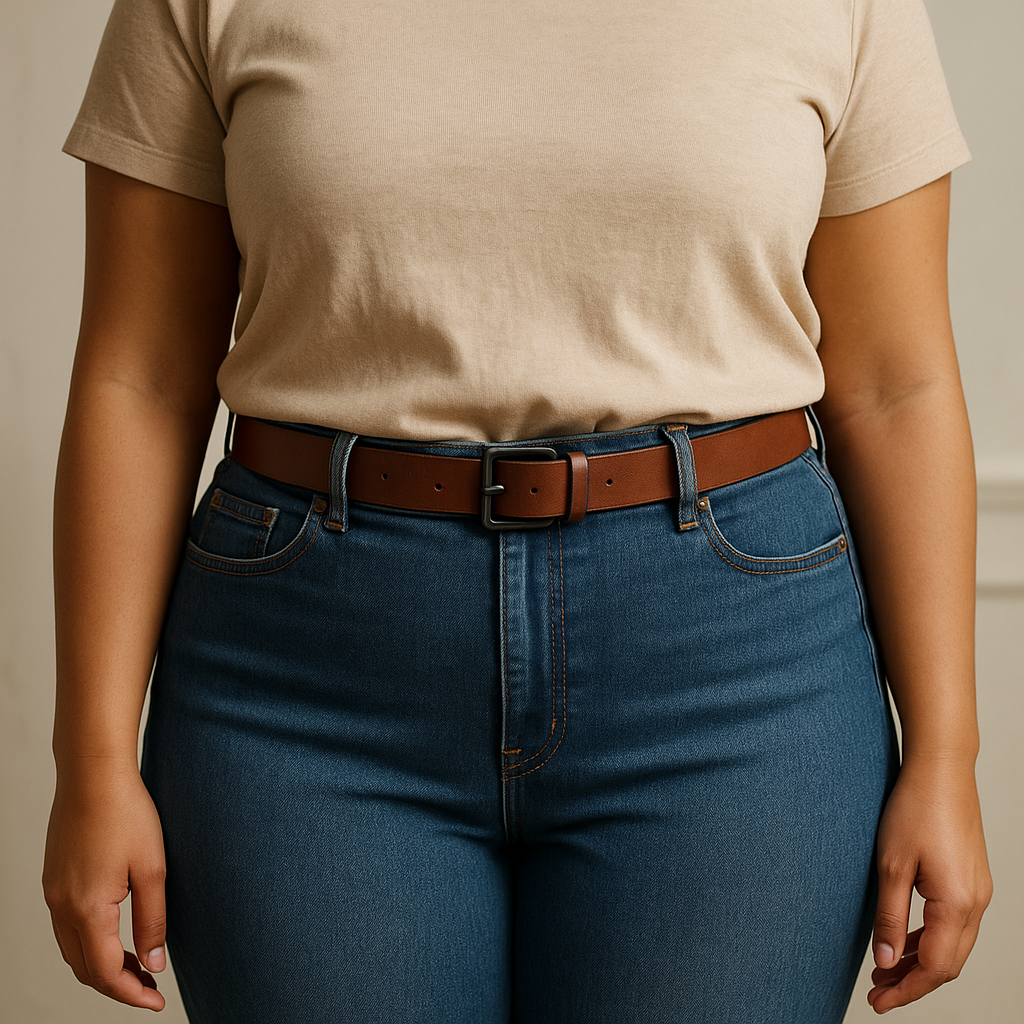
If you carry more volume through your hips and thighs (my people), the internet loves to hand you the same advice: add a belt to define the waist. Sure. But a belt that sits right on the narrowest point of your torso often does one annoying thing: it makes your hips look like they start immediately under the belt. It’s not that your shape is wrong. It’s that the belt placement creates a hard line, and the eye reads everything below it as one big block.
What works better on me is treating the belt like a quiet boundary, not a headline. I use a medium-width belt (think 1 to 1.5 inches) in a color close to my pants or skirt, and I wear it at the actual waistband, not up at my ribcage. When I’m in high-rise jeans, that means the belt buckle sits slightly lower than where my waist is smallest, and that’s the point. The outfit looks longer, and I don’t get that “hourglass drawn with a Sharpie” effect.
Two practical notes from too many mornings of outfit thrashing: First, buckles matter more than people admit. A big round buckle centered over a lower belly is a magnet for attention, and it can visually widen the front of the hips. I reach for a flatter, more minimal buckle (Loft and Madewell both make good everyday options) or even a square frame buckle that reads like hardware instead of jewelry. Second, if you’re doing a French tuck, keep it messy on purpose. A perfectly smoothed tuck plus a tight belt is where the harsh line shows up. I tug a little fabric back out so it blouses slightly over the belt, then I’m done. No extra cinch, no fighting my own proportions.
Apple and straight shapes: try off-center before you size up
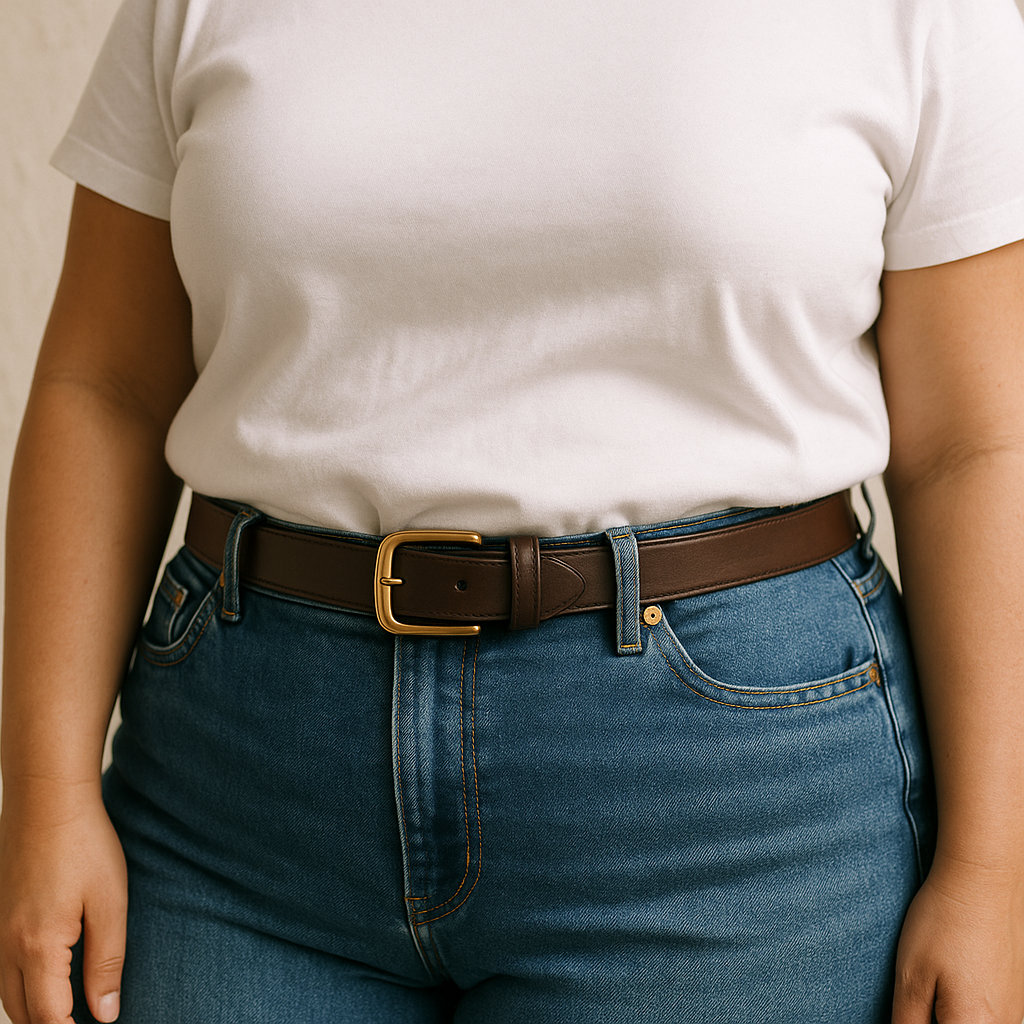
If your midsection is where you carry weight, or your waist-to-hip difference is subtle, belts can turn into a tiny daily insult: you buckle them, sit down, and the front digs while the back floats. The usual fix is get a stretch belt or size up, and that can help, but it also tends to create that diaper-ish ripple under tops. The thing I change first is simpler: I stop insisting the buckle belongs at dead center.
Put the belt on normally, then rotate it so the buckle lands about two belt loops to the left of center (or right, if that’s your habit). Not on your hip bone, just off the bullseye. That small shift does two nice things. One, it moves the thickest part of the belt (the buckle stack) away from the exact point where many of us have the most curve. Two, it looks intentional, like styling, instead of “this belt is fighting for its life.” I do this most with jeans that have a thicker waistband seam, because the buckle is already competing with a lot of bulk at the front.
Now for the part nobody says out loud: if the belt is leaving a deep imprint, the leather isn’t automatically too small. Sometimes the waistband is the issue. High-rise denim with a firm, non-stretch top edge (hello, some vintage-wash Levi’s) can press into the belly when you sit, and the belt just amplifies it. On those days, I’ll use a thinner belt, closer to 0.75 to 1 inch, and I’ll keep the hole choice honest. If you’re between holes, don’t crank to the tighter one and hope for the best. Use the looser hole and rely on the belt for polish, not compression.
One more detail that comes from wearing this all day: tops. A clingy knit that ends exactly at the belt line will highlight every ridge, no matter your body type. I prefer a tee with a little structure (a slightly heavier cotton) or a button-down with a soft drape. The belt’s job here is to add a finished edge and a bit of hardware, not to create a dramatic before and after.
Petite frames: belts look chunky fast, so go narrower (and quieter)
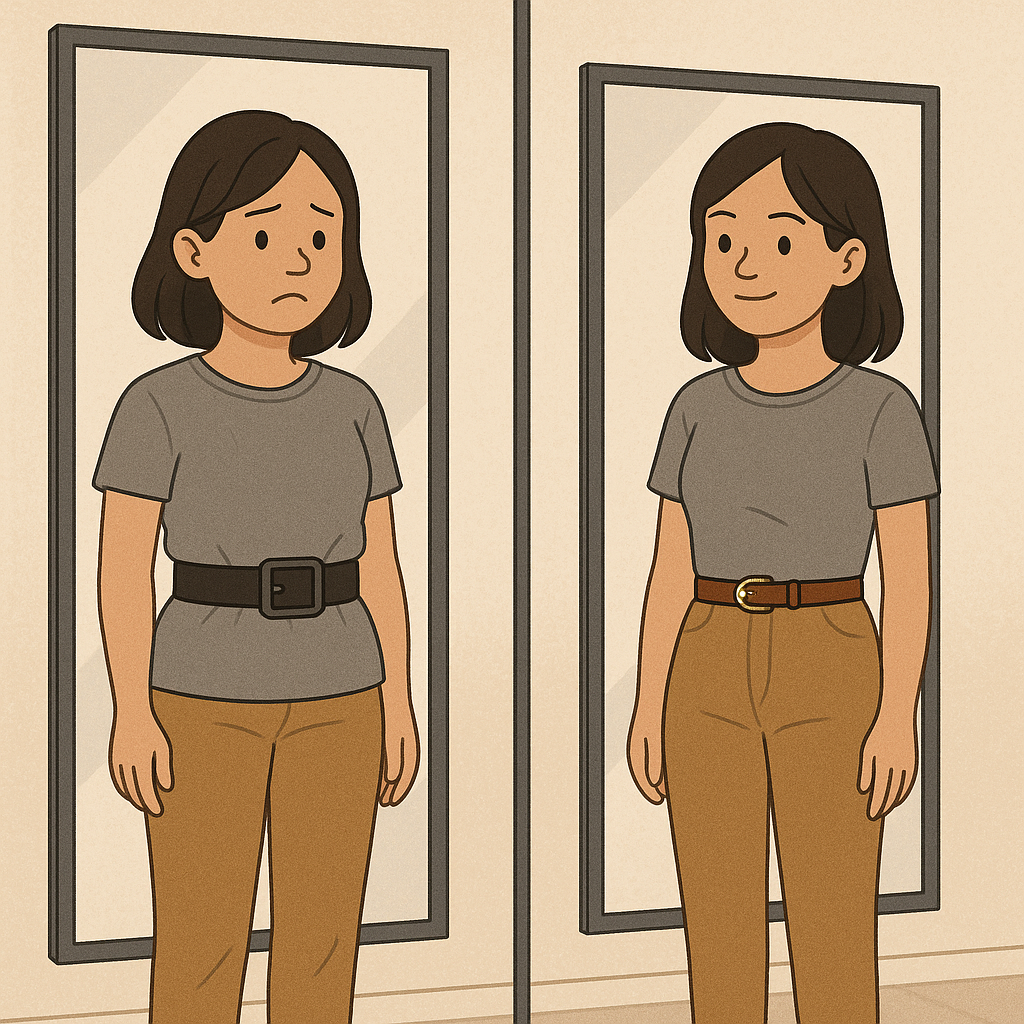
Petite styling advice loves drama. Add a statement belt! Define your waist! Meanwhile, if you’re 5’2″ with a short torso, a wide belt can take up an entire visual third of your body. I’ve watched it happen in the mirror: the belt becomes the outfit, and everything above and below it looks like it got cropped by accident.
My fix is boring, and that’s why it works. I go narrow, usually 0.5 to 0.75 inch, and I keep the buckle low-profile. Think small oval, small rectangle, or a simple prong buckle that sits flat. When the buckle sticks out, it can push a top forward and make the midsection look puffier than it is, especially with lightweight fabrics. A slim belt also plays nicer with petite-friendly trousers that often have smaller belt loops. If you’re forcing a belt through the loops, it’s too thick, and you’ll see the distortion at the waistband.
Color is the other part people skip. If you want length, match the belt to your bottoms as closely as you can. Not black belt with dark wash, but truly close: a warm tan belt with camel pants, a black belt with black denim, a deep brown belt with chocolate trousers. The goal is to avoid a high-contrast stripe that cuts you in half. When I do want contrast, I choose it with a reason, like matching the belt to my shoes or bag hardware, and I keep the rest of the outfit simple so it reads like a deliberate accessory choice.
One last real-world trick: if you’re wearing a dress and you’re petite, the belt doesn’t have to sit at your natural waist. On me, a belt placed slightly higher can shorten the torso even more, so I test it in the mirror by moving it down an inch at a time until the proportions stop looking stacked. It’s a small adjustment, but it’s the difference between looking neatly styled and looking like the belt is holding the outfit hostage.